Welcome to zctower
Language:
 ∷
∷

∷
 ∷
∷


For international maritime logistics and cross-border freight, choosing the right container lock is not just an operational choice—it is a strict legal requirement. If your shipment uses substandard locks, your cargo risks theft, tampering, and costly customs rejections at global ports.
To secure your heavy-duty freight, logistics managers must utilize ISO 17712 certified bolt seals, also legally recognized as High-Security Seals (Class H).
A container bolt seal is a heavy-duty, one-time-use security device consisting of two parts: a solid metal pin (male component) and a locking earpiece/chamber (female component).
To meet global maritime standards, a professional bolt lock must comply with the strict ISO 17712 standard and be C-TPAT compliant. These certifications ensure that the seal has undergone physical laboratory testing for tensile, shear, bending, and impact strength, proving it can withstand heavy physical stress during ocean transport. Without these certified documents, containers are highly likely to be held up by customs officials during cross-border transits.
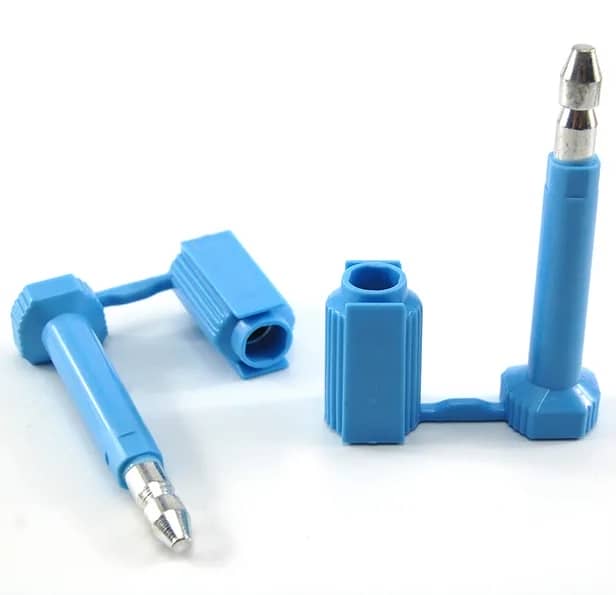
When auditing a manufacturer or sourcing bulk supplies, never rely on a generic steel pin. Premium high-security container seals must possess three distinct anti-tamper technologies:
Anti-Spin Construction: Experienced thieves try to spin the bolt shaft at high speeds to unscrew or weaken the locking core without breaking the outer plastic shell. Look for designs with an anti-spin mechanism to completely eliminate rotation tampering.
Heavy-Duty Core Material: The inner shaft should feature a minimum of an 8mm thick hardened carbon steel core, typically wrapped in high-impact ABS plastic, providing a high breaking strength that can only be breached using industrial bolt cutters.
Dual Laser-Etched Serialization: Fraudsters frequently attempt to swap components between different locks. To counter this, reliable manufacturers ensure that identical, non-repeated serial numbers are permanently laser-etched onto both the bolt shaft and the locking body.
In mass-scale port operations, terminal workers and border agents must verify thousands of container locks every hour. Automated tracing elements are essential for efficiency:
High-Visibility Colors:Opting for vibrant colors—such as a bright yellow or neon orange—dramatically improves visibility for port inspectors checking locking rods from a distance or under low-light conditions.
Advanced Data Tracking: Modern bulk supply chains require laser-engraved high-density barcodes or QR codes. This enables automated tracking, allowing logistical personnel to scan container data into the digital manifest instantly, creating an unalterable digital audit trail.
Contact: Cherry Deng
Phone: +86 15305911267
Tel: +86 0591-83656592
Email: cherry@zcsecurityseals.com
Add: Building 15, Phase II, Tus-Science & Technology City, Yaoxi Road, Minhou County, Fuzhou City, Fujian Province